
Reduce stress? Find the right knob to turn!
Stress costs a lot of money, does work pressure too?
According to research by TNO, absenteeism due to work stress costs employers 3.2 billion euros annually. This figure does not include the costs of 'grey absenteeism' (reduced productivity) caused by stress. In short, we are talking about a significant amount.
In reporting on this topic, the terms workload and work stress are often used interchangeably. Stress is therefore often seen as a direct consequence of high workload. But is that really the case?
Measures have not yet had the desired effect
The Working Conditions Act explicitly addresses psychosocial work load (PSA). Work pressure and undesirable forms of interaction from colleagues or third parties (such as patients, customers, etc.) are explicitly identified as causes of stress. Employers are required to implement policies to prevent or limit PSA. It is therefore a standard component of the Risk Inventory & Evaluation (RI&E) and often leads to further investigation, for example in the form of a Preventive Medical Examination (PMO).
This is an example of how the perception (or let's say, 'the confusion of tongues') is perpetuated that workload and work stress have a direct cause-and-effect relationship. Partly as a result of this, many employers focus primarily on how they can reduce their employees' workload. Often by giving employees more autonomy and by introducing flexible working hours.
Unfortunately, we see that this does not yet have the desired effect. The costs resulting from work stress continue to rise every year.

But what exactly is the difference between workload and work stress?
To clear up any confusion, we use the following descriptions for the terms workload and (work) stress.
- Work pressure can be described as the pressure you feel to complete your work on time and in full. In short, the amount of work plays a role in this, but so does the amount of time you have for it.
- Having (work) stress can be described as the presence of symptoms associated with the activation of the body's stress system (involving, among other things, the release of the stress hormone cortisol). If only one symptom occurs, a person will not immediately associate it with stress. However, this does happen when there are multiple symptoms and they occur frequently. Examples of such symptoms include headaches, concentration problems, poor sleep, muscle tension, irritability, et cetera.
The decision was deliberately made to put the word 'work' in parentheses regarding work stress. After all, it is impossible to separate work and private life within a single person. Situations at work can lead to stress symptoms, but the same applies to private situations.
Looking at these descriptions, you can also deduce that workload and work stress are indeed related. If you frequently have to work under high pressure, this will result in stress-related symptoms. After all, stress is primarily nothing more than a physical response to a signal that the body needs to be active and ready. If you have to work a lot and hard, that is exactly what will happen.
However, there is not a fully causal link. That would imply that all employees in a department with high work pressure would eventually develop severe stress-related symptoms and ultimately start taking sick leave. But senior executives, CEOs, or let's say the Prime Minister of this country, will also often experience very high work pressure. They have a lot of work to do, work long days, and must make important decisions under pressure. And yet, the stress they experience (and they undoubtedly do) is not so high that it leads to absenteeism, for example. In fact, this group of people may well be absent the least of all.
What, then, is the relationship between sources of stress and sources of energy?
To nuance the picture, one must look not only at the factors that can cause stress, but also at the factors that can actually have a positive influence on the body's stress system. And, as will become apparent, there are factors that can work both ways.
After all, consider this: if you are highly committed to the organization, enjoy your work, feel you have the freedom to organize your work as you see fit, and the work is very important to you, you can probably accept the higher workload.
However, if you do not have a good relationship with your colleagues, your supervisor shows little appreciation for the work you do, and you are unable to meet obligations at home due to the extra work, high work pressure will also feel particularly heavy and lead to complaints.
When considering the factors that can influence the presence or development of stress symptoms, we distinguish the following:
- Work pressure
- Autonomy
- Social support (from colleagues, supervisors, or possibly the family)
- Job satisfaction
- Involvement
- Fit for work
- Importance of the work
- Work-life balance
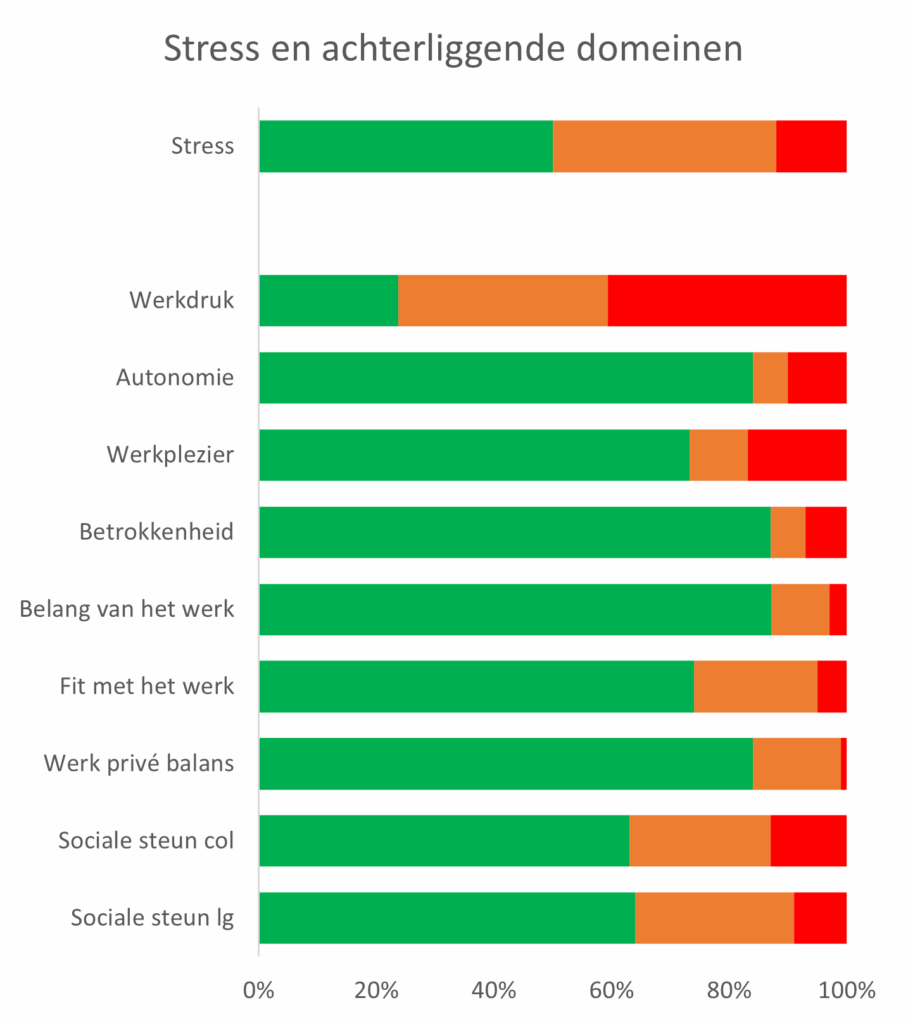
These factors are known to contribute to 'more energy' at work (engagement), or conversely, lead to stress. We can express this in terms of high and low risks of developing symptoms (in the long term). In the graphs, this is represented by a green (no/low risk), orange (moderate risk), or red (high risk) color.
Is it possible to make visible how significant those risks are?
These risks can be quantified through data analysis from various customer studies where the aforementioned factors have been measured.
The focus was on how employees score collectively and whether 'trends' are visible on specific themes. This does not concern an average, but rather the percentage of employees at increased risk regarding a particular theme. There are various ways to analyze the results and conduct follow-up research.
To gain insight into the magnitude of the risks and how they relate to one another, the strength of stress correlation is examined per theme.
Correlating scores
This approach examines the prevalence of stress within the high-risk and low-risk subgroups regarding a specific theme. This perspective does not so much serve to assign a score or judgment to the company in question, but rather helps identify the levers that need to be adjusted to reduce a particular risk.
It is known that (long-term) stress symptoms are a major cause of mental absenteeism. And we have just seen that there are various factors that contribute to stress. It is therefore interesting to know which factor makes the greatest contribution to this. To this end, we will examine the prevalence of stress among the various 'subgroups' that can be formed based on the score achieved on a specific component.
If job satisfaction had no influence on stress, then almost as much stress should occur in the subgroup 'employees with high job satisfaction' as in the subgroup 'employees with low job satisfaction'. This correlation can be investigated by examining the prevalence of stress for each of the mentioned factors.
Thus, 12% of all participants reported many stress-related complaints and, as a result, runs a high risk of mental absenteeism. Furthermore, 41% of all participants indicate experiencing significantly increased work pressure. These individual figures already say something about the presence of risks for health complaints; the underlying questionnaires have, after all, been validated in this regard. However, this does not directly indicate how the potential risk of complaints and absenteeism can be reduced. To do so, it is necessary to gain insight into the impact that a specific factor has on (in this case) stress.
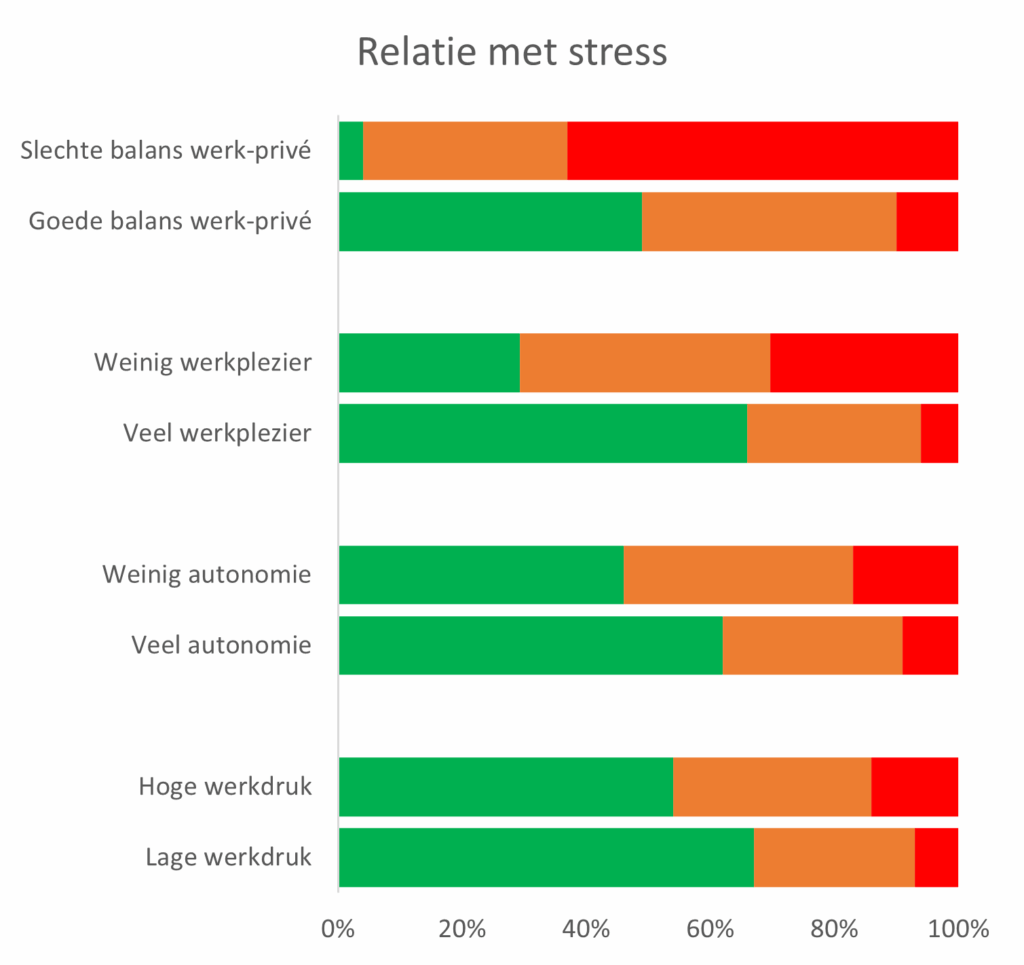
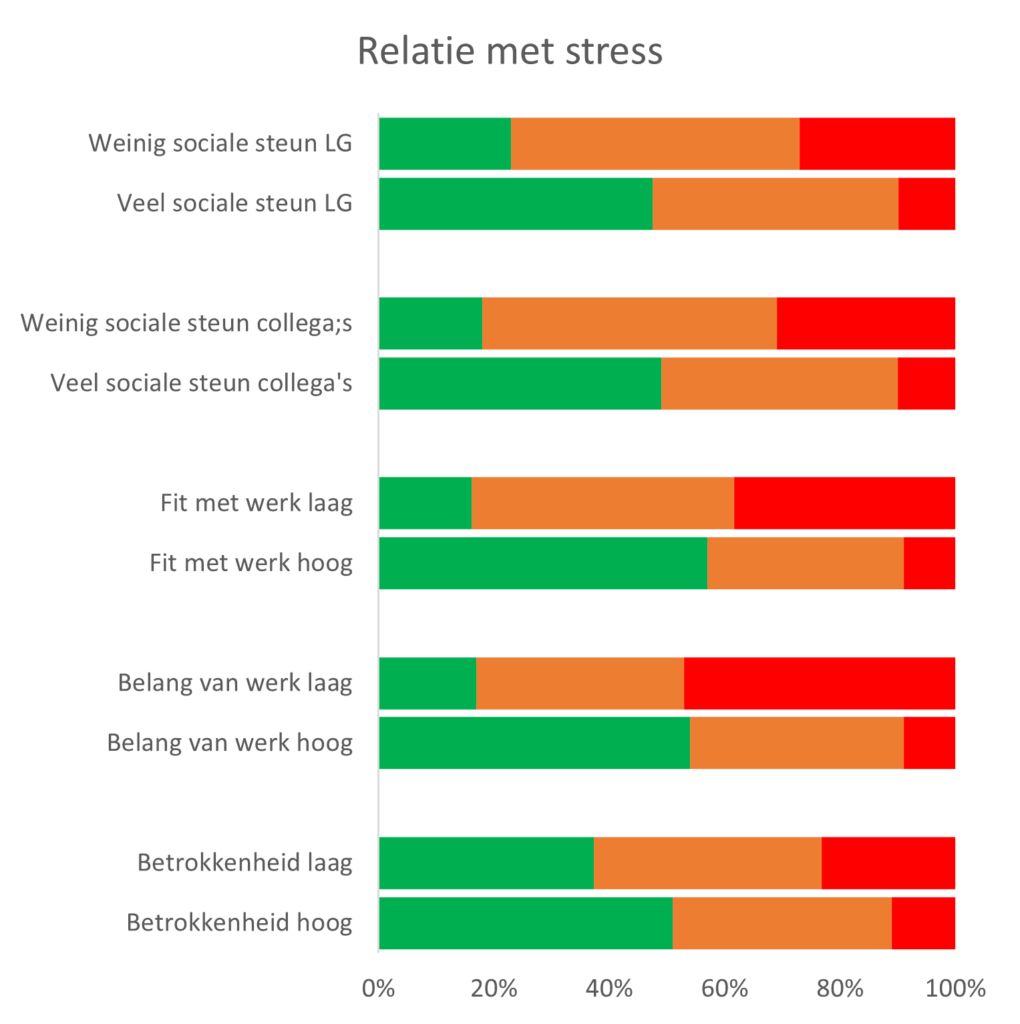
To quantify how the underlying domains relate to stress, we examined the extremes (the very good and very bad scores) within each domain and determined the structure of the stress score within that subgroup. This is shown in the graphs below.
If we limit ourselves to only the red stress scores for the conclusions (the percentage mentioned below is therefore the percentage of employees with severe stress symptoms), the following overview can be created.
| Domain | With a good score | With a bad score | Factor |
|---|---|---|---|
| Work pressure | 8% | 16% | 2,05 |
| Autonomy | 11% | 21% | 1,88 |
| Job satisfaction | 8% | 32% | 4,19 |
| Work-life balance | 11% | 62% | 5,41 |
| Involvement | 11% | 23% | 2,17 |
| Importance of the work | 9% | 47% | 5,01 |
| Fit for work | 9% | 38% | 4,48 |
| Social support from colleagues | 10% | 31% | 3,03 |
| Social support for manager | 10% | 27% | 2,79 |
The table above shows that all domains that can be linked to stress symptoms based on theory actually appear to influence the experience of stress symptoms. It is particularly striking that the domain of job satisfaction shows a very strong correlation with stress.
(In the domains of work-life balance, importance of work, and fit with work, this correlation is very strong; however, the number of employees scoring poorly on these is relatively low, which is why some caution is advised when drawing conclusions.)
Reframing
Incidentally, you could also read the table above in reverse and approach it from the perspective that if you enjoy your work or have a low workload, you will experience severe stress symptoms much less frequently. If you look at it that way, we see that only 6% of the participants with high job satisfaction and 7% of the participants with a low workload have severe stress symptoms. Whereas the average is 12%.
What does this teach us…?
It should be clear that whether or not stress-related symptoms develop is individually determined. If there were a strong causal link between workload and stress, the percentages associated with 'high stress' and 'high workload' should be closer together. (There are statistical methods to quantify this, but that goes beyond the scope of this discussion.)
Does it make sense for an employer to do something about this, then?
As an employer, you have influence on the amount of work pressure and the autonomy you grant to employees. This applies up to a certain limit. Work is simply stressful; that can never be completely eliminated. Furthermore, you cannot give employees unlimited autonomy and let them decide entirely for themselves how they do their work; work agreements must be made that they must follow. This also applies, to some extent, to the work-life balance. As an employer, you can give employees space to pursue private activities that are important to them, but within certain boundaries.
The other factors are more individually determined. That would suggest that you, as an employer, have less influence on these, but nothing could be further from the truth. Let's take a closer look.
The domains of engagement and importance of work, for example, depend among other things on the value work holds for an individual. Is work a means to earn money, or does someone experience it as a useful contribution to society or to the fulfillment of a life purpose?
The same applies to the right job fit, albeit in a different way. On the one hand, the work should align with the knowledge, education, and skills an individual brings to the table. However, here too, the employee wants to feel that the work suits them. If one of your personal core values is wanting to do good for other people, this is sometimes difficult to reconcile with a sales position where you have to sell something you do not believe in.
As an employer, you can discuss this with your employees; in fact, you *should*. What actually motivates someone, and can they find that at work? Or do they draw that energy from activities outside of work, such as volunteering for an association or a church? It is not a problem if someone's 'energy source' lies outside of work, but do bear in mind that when you, as an employer, implement certain work agreements, this can have negative consequences for an individual employee. This can lead to someone experiencing stress when you might not expect it. After all, if the workload does not really change, the mere fact that someone can no longer draw on their energy source can still cause stress-related symptoms.
The domains of job satisfaction and social support from colleagues and supervisors are linked to the atmosphere and culture within a department and within the company. Do people interact pleasantly with one another, and do they support and help each other when necessary? As an employer, you can address this by implementing interventions regarding workplace happiness and job satisfaction. Although this may seem intangible and unchangeable, there is more that can be done about it than appears at first glance.

In short…
It should be clear that mental absenteeism, stress, and the development of stress-related complaints are the result of a complex process in which various energy sources and stressors play a role. The primary reflex to put the topic of 'work pressure' on the agenda and make new work agreements in the event of mental absenteeism or stress is well-intentioned and will certainly have an effect. However, it is much more than that. Much more important is ensuring that the right conversation is held with all employees. That they can discover for themselves what gives them energy and how their work can contribute to this. In this way, you develop engaged employees who value their work in the right way and for whom work has a clear place in the employee's life, alongside other activities they can perform. The result is that employees go to work with pleasure and feel supported by their colleagues and their manager. And all this ensures that during busier times at work, employees can handle it and, if necessary, receive the right help at the right time from the right person.
Where can I start?
To conduct such a survey for your own employees, you must start by mapping out the themes that have been mentioned. By comparing these with your own figures from departments or absenteeism, you can create your own analysis and see where you stand.
FitzMe is happy to review the situation with you. We have developed a questionnaire that measures all these factors. This questionnaire can be used as a standalone instrument or as part of the PMO. In addition to the themes mentioned, other, more lifestyle-oriented themes are also measured. In this way, the employee gains broad insight into the current status quo, and areas for improvement become visible to address in order to maintain high employability. The vitality coach who discusses the results with the participant and performs any additional measurements establishes the connections and asks follow-up questions where necessary.